


Mixing, finding the right balance for your track
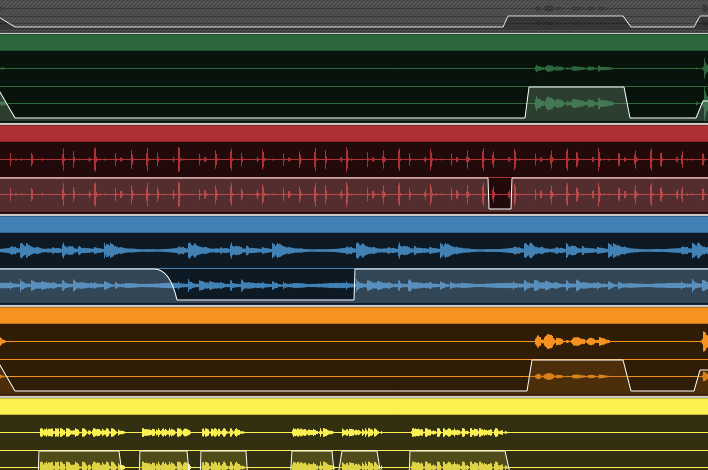
Mixing is the stage where the recorded takes truly begin to form a track. It is not simply a matter of balancing levels or correcting flaws, but of bringing out an intention, creating space, coherence and movement without erasing what gives the project its identity.
I therefore try less to impose a particular colour than to understand what the track needs. Depending on the project, this may involve very subtle work or, on the contrary, more pronounced choices in terms of sound, arrangement or dynamics.
WHAT MIXING INCLUDES
-
Reference-based mixing
-
Development of the sonic identity
-
Track cleaning and optimisation
-
Timing and pitch corrections
WORKING FROM YOUR RECORDINGS
I regularly work from tracks recorded by the artists themselves, sometimes under conditions very different from those of a studio. The tracks are not simply imported and mixed as they are: they are first listened to individually, cleaned up and optimised where necessary, with timing or pitch corrections, removal of unwanted noise, level adjustments or other interventions that provide a solid starting point.
When a take has a problem that cannot be properly corrected during mixing, I may ask the artist to record it again. If this is not possible, other solutions can be considered depending on the instrument and the nature of the problem.
This work always remains in service of the track as it was originally conceived. I aim to preserve its identity, character and the artist’s intention. Mixing, processing and corrective decisions are made with this in mind; I do not transform a project by imposing an aesthetic that does not belong to it.
BEFORE MIXING
Before starting the mix, I listen to the track as a whole and assess the state of the individual tracks, any problems that may need correcting and the intended sonic direction.
I start from the artist’s brief, but I do not necessarily limit myself to it. I may suggest other directions for development, processing ideas or reference tracks that seem relevant to the project. These suggestions often come from listening and intuition: they are a way of exploring directions the artist may not necessarily have considered, without ever losing sight of the track’s identity.
The references then provide concrete points of comparison in terms of balance, dynamics, tone, space and production level. They are not intended to reproduce another track, but to place the project within a current musical and sonic reality and to define the direction of the mix more precisely.
This stage also helps identify anything that still needs to be prepared or reworked before the actual mixing process begins.
DURING MIXING
The mix develops in stages. I first prepare an initial version that is developed enough to establish a clear direction for the track, then send it to the artist to gather their feedback and make sure the work is heading in the right direction.
When several options seem worth exploring, I may also provide two or three intermediate versions with deliberately different choices, for example in terms of balance, space, effects or certain sonic approaches. The aim is to compare several directions concretely before taking the most convincing one further.
Through these exchanges, the mix gradually evolves into an increasingly precise and coherent version, until the final mix is approved.
MIXING EXAMPLES
A few excerpts from sessions recorded at the studio, illustrating different types of instruments and vocal setups.
ARRANGEMENTS AND ADDITIONAL PARTS
The work can sometimes go beyond the strict scope of mixing. If listening to the project reveals something missing or an opportunity for further development, I may suggest interventions involving arrangement or production, always in agreement with the artist and in keeping with the identity already established.
This can include creating melodic lines, adding guitars, keyboards, basses or drums, as well as additional vocals or backing vocals. The aim is not to make the track artificially denser, but to intervene when a new part can strengthen an intention, improve the arrangement or add something that is genuinely missing from the project.
I can also work from MIDI files and suggest different sounds or virtual instruments (VSTs) for the same part. In some cases, an audio track can be converted to MIDI in order to preserve the original performance while trying different instruments or sounds. For bass, drums or certain programmed parts, this can make it possible to test different sounds or replacement samples before considering a new recording.
If these solutions do not produce a sufficiently convincing result, and if the instrument allows it, I can also offer to replay the part myself. Re-recording is therefore a last resort rather than an automatic response.
These ideas may arise during the initial listening stage or later during the mixing process, when the work reveals the possibilities or limitations of the arrangement more clearly. They are discussed with the artist before being incorporated.
These interventions can be part of a mixing project, but they can also be offered as a separate service. I can therefore create, perform or rework an instrumental part and provide the audio or MIDI files for direct integration into the artist’s project.
A PROJECT SUPPORTED BY TQIDr
I do not consider mixing to be an isolated service. I select projects that I genuinely want to invest myself in and that TQIDr wishes to support beyond the sonic work itself.
Once the release is finalised, it joins the label catalogue and receives the same support as other projects followed by TQIDr: teaser creation, communication around the release and promotion across the label’s social media.
This editorial selection allows me to commit to projects where I believe I can contribute something artistically and that I want to support through to their release.
AFTER MIXING
Once the mix has been completed and approved, the project generally moves on to mastering. This final stage helps refine the overall balance, dynamics and loudness, before preparing the files for release. The release can then be supported through to its digital distribution on streaming platforms.

A PROJECT TO MIX?
Before starting, I prefer to listen to the tracks, understand their direction and assess the state of the individual tracks in order to evaluate the work involved. This makes it possible to identify any preparatory stages, additional interventions that may be useful and to provide a quote suited to the project.
We can then define the direction of the mix together, along with the different stages of support through to the release.